
What Is a Desktop AI Hologram? Full 2026 Category Guide
In 2026 several manufacturers are racing to put a physically present AI on your desk. We explain what this category actually is, who really makes it up, and what sets it apart from a plain voice assistant.
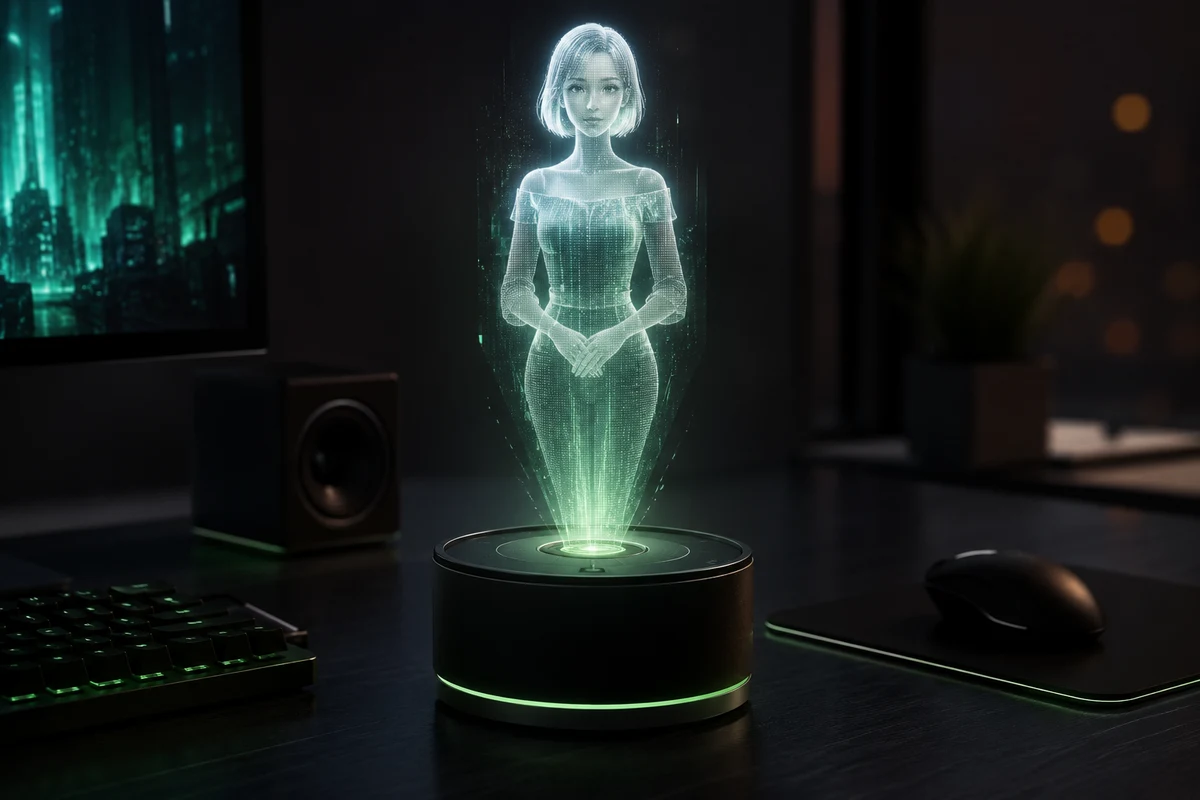
CES 2026 made one trend clear: AI is moving out of apps and speakers and taking physical form on the desk. Razer, Lepro, and Samsung each showed a different take on the same idea — an AI companion with visual presence — while Gatebox, the Japanese pioneer of the format, is preparing its first real attempt to expand beyond Japan. This guide explains what a desktop AI hologram is (and isn't) in 2026, and who actually makes up the category with real hardware today.
Update — Sep 17, 2026
"Lepro Ami" now has a brand name: at IFA Berlin, Lepro spun it off as Everthine A1, an independent product. We've updated the table and the analysis in section 03 with the new name and everything confirmed since then (mobile app, tiered pricing, regional rollout order).
01.What a desktop AI hologram actually is
A desktop "AI hologram" is a physical device that projects or renders a visual avatar — human, animal, or abstract — on a small screen, optical lens, or projection system, and responds by voice using a conversational AI model. It isn't a smart speaker (Alexa, Siri), because it has its own visual presence, and it isn't a companion app like Grok's characters, because it exists as a physical object independent of a phone or browser.
Dedicated hardware
A physical object on the desk, not just an app or a speaker skin
Visual presence
A rendered avatar (2D, 3D, or holographic-style), not just a light or LED
Conversational AI
Responds and acts by voice or text, not a static figure or screensaver
02.What is NOT an AI hologram (even if it looks like one)
The "AI companion" label is being used loosely in 2026, and it's worth drawing a line. At its own CES 2026 event, Samsung unveiled the "Vision AI Companion" — an AI feature built into its 2026 TV and audio lineup that suggests what to watch or eat based on context. It's a useful assistant, but it's software inside a television, not a dedicated device with its own avatar — it isn't competing in the same category as Razer AVA or Everthine A1.
Something similar applies to Gatebox, the Japanese brand that popularized the idea of a "holographic assistant" back in the 2010s. Its current model, sold only in Japan, displays a VRM avatar inside a glass case, but doesn't include real conversational AI — it works more like an interactive digital figure than an AI agent. Gatebox 3, unveiled at CES 2026 with real intelligence added, is still in crowdfunding stage, not on sale.
Why the distinction matters: if a category comparison mixes TV software, AI-free figures, and real hardware with an open local AI ecosystem, price and availability comparisons stop making sense. This guide only covers physical devices with real conversational AI.
03.Who actually makes up the category today
| Razer AVA | Everthine A1 | Gatebox | |
|---|---|---|---|
| Conversational AI | Yes (agentic, AIKit SDK) | Yes (empathetic multimodal) | No (VRM avatar, no real AI) |
| Price | ~$270 / ~€249 (unofficial) | Not announced | Gatebox 3: ¥200,000 planned (~$1,260), plus an AI fee of roughly ¥500-1,000 a month |
| Availability | Early 2027, Early Access (US reservations open) | Announced since Jul. 2026 (as Lepro Ami), unconfirmed | On sale (current model) |
| Where it sells | US confirmed, Europe/LATAM pending | Planned US first, then Europe and Japan, no per-market date | Japan. Gatebox 3 aims to go abroad, no date yet |
Sources: Lepro's press release (CES 2026, via PR Newswire), USA Wire and TechBullion's IFA Berlin 2026 coverage of the Everthine A1 launch, Gatebox 3 coverage on Mogura VR, and Razer AVA's availability page. Verified as of September 2026 — actual availability may change.
Razer AVA is today the only one of the three with a genuinely open buying path: $20-deposit reservations in the US and an open local AI toolkit (AIKit) already in developers' hands, though Europe and LATAM still have no date — we track the signals from IFA Berlin for that step. Everthine A1 is the continuation of what was shown at CES 2026 as "Lepro Ami": Lepro, an already-established brand with 40M+ users across North America, Europe, and Asia through its smart lighting line, spun it off at IFA Berlin into an independent brand. That makes broad future distribution plausible, but the A1 itself still hasn't confirmed a market-by-market rollout or final price. Since IFA we do know the rest of the product plan — a mobile app for iOS/Android, tiered pricing (free + 2 paid tiers), and a rollout starting in the US, then Europe and Japan. Gatebox is the historical pioneer of the idea — it's sold its "digital figure" in Japan for over a decade — but its current product has no real conversational AI, and Gatebox 3 (which would have it) is still in funding stage, with no shipping date outside Japan.
Scope note: we leave out of this comparison companions with no dedicated hardware (like xAI's Grok characters, which xAI retired in July 2026) and projects that haven't shown a working physical product yet.
04.Why this category is growing in 2026 (and why it's early for everyone)
CES 2026 was the first event where several well-resourced manufacturers — Razer, Lepro, and even Samsung with its own take on the concept — unveiled a version of "physically present AI" in the same month. That's a signal of a real emerging category, not a single isolated product. But it's worth not confusing "several CES announcements" with "a mature category": of the three physical, real-AI devices in this guide, only one currently has open reservations and a working SDK, and none has yet confirmed simultaneous sale in the US, Europe, and Asia.
Our Take
The AI hologram category is real, but as of September 2026 it's still more an announcement race than a market with comparable supply. Our take is that Razer AVA starts with an advantage for one concrete, verifiable reason: it's the only one with an active buying path (a deposit reservation) and an open local AI toolkit (AIKit) already in developers' hands, not just a trade-show promise. Everthine's ambition (the brand Lepro created for the A1) is credible because its parent company already has real distribution across three continents with other products, and since IFA there's a more concrete product plan than back in January — app, pricing tiers, rollout order — but the A1 itself has been missing the availability date it announced under the Lepro Ami name since July 2026, and still has no final price. And Gatebox, despite inventing the idea, currently sells a product with no real conversational AI outside Japan — its truly AI-powered version still depends on a funding campaign landing successfully. For anyone evaluating this category from Europe or LATAM, the practical takeaway is the same in all three cases: there's still no confirmed shipping date outside the US or Japan, so "available in 2026" and "available to you in 2026" aren't the same thing. The real test of whether this category is a market or just trade-show hype will come with the year-end shopping season: if Razer is still the only one of the three to have put real units in real buyers' hands by then, the question stops being "which is the best AI hologram" and simply becomes "there is an AI hologram, and it's Razer's" — with Everthine and Gatebox reduced to a footnote about who showed up late.
Can You Reserve Razer AVA Now?
Yes, in the US, with a refundable $20 deposit. Check the reservation status for Europe and LATAM on our availability page.
CHECK AVAILABILITY & DATES